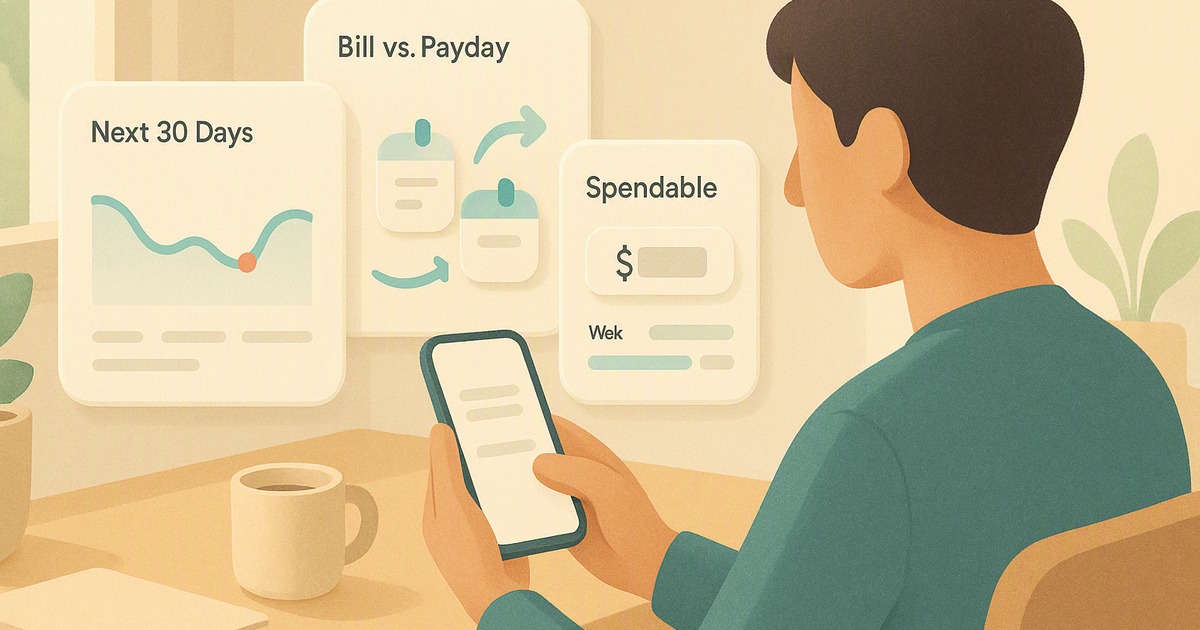
The AI Cash-Flow Tracker That Flags the Shortfall Before It Happens.
Payday on the 25th, rent on the 1st, a card autopay on the 28th — Today lines the next 30 days up on one curve, shows what is genuinely spendable each week, and red-flags the bill that will outrun the balance weeks before it lands. Not after a $35 overdraft fee.
$610 this week, after rent and the savings transfer clear.
Flagged 12 days early
Card bill $740 on the 28th — balance will be ~$610. Shift it or top up.
Reads signals from —Calendarpaydays and due datesCard & bank statement exportsthe balances and spending you importEmailbills and payment noticesCheck-inscash and irregular incomeSpreadsheetsincome plans and buffers
A Forecast Should Arrive Before the Overdraft Fee.
Banking apps tell you after the fact — a notification about a returned payment, a balance that dipped negative. By then the $35 fee is charged and the weekend is spent rearranging. The useful version of a cash-flow forecast lands while there is still time to move a bill, top up an account or cut a spend.
A banking app's balance screen
A bounced payment and a $35 fee, discovered after
Bills listed in isolation, no shape of the month
A vague feeling that this month is tight
Squeezing by on memory and guesswork
Today · your AI cash-flow tracker
A flag three weeks ahead, while there is still time to act
Paydays, bills and spendable cash on one 30-day curve
One number: what you can genuinely spend this week
Gentle nudges to log income, top-ups and big one-offs
What a Cash-Flow Tracker Should Really Warn You About.
The Next 30 Days on One Curve
Payday on the 25th, rent on the 1st, that quarterly insurance on the 10th — income and fixed bills line up across the month, so the tight window between the 1st and the 25th shows up weeks before it actually bites.
Warned Before the Bill Bounces, Not After a Fee
When the 28th's card payment will outrun what is in the account, Today flags it early — with the amount, the date and how much needs to shift. No $35 surprise found in a week-old alert.
One Number for 'What Can I Actually Spend This Week?'
After the bills and the savings transfer are covered, Today hands you a single spendable figure for the week — not five account balances to reconcile by hand on a Friday night.
Bill Days That Dodge the Payday Crunch
Card due date lands two days before payday, every single month? Today spots the pattern and suggests moving the payment window to just after the 25th — then reminds you to set it up in your banking app.
Big Outlier Spend, Snapped When It Happens
A $600 flight or the car repair that eats a week — photograph the receipt or log it once and Today treats it as a one-off, so it never silently skews what the next few weeks can really absorb.
A Multi-Account View You Assemble Yourself
Two bank accounts, a shared pot and a credit card — import each month's statement and see the combined picture for the month. Nothing is connected; every account stays exactly where it is.
Four Cash-Flow Problems, One Forecast That Sees Them Early.
Different incomes, different calendars — the forecast is built from the paydays and bills you actually have.
Payday on the 25th, Rent on the 1st
Salaried, but the card bill lands on the 28th — three days before payday — and January always creaks. Today red-flags the 28th window with days of runway left, suggests shifting the due date, and shows exactly what the week between rent and payday can spend.
The 28th shortfall flagged while there is time to act
A suggested new card due date after payday
A spendable number for the gap between rent and payday
Freelance Income That Never Lands Twice the Same Way
Invoices clear whenever clients feel like it, so a fixed 'budget' is fiction. Today works in ranges: the leanest month in your recent history sets the floor, and a dry three weeks is flagged weeks before the rent needs to clear.
Dry spells flagged before the rent is due
Income ranges instead of a fictional fixed number
A tax slice kept aside as invoices clear
Just Moved, and Every Cost Is New
Deposit month, removal costs, first utility bills that arrive at odd times — last month's numbers say nothing about this one. Today marks the one-offs as outliers, recalibrates as each new bill lands, and keeps the forecast honest instead of quietly optimistic.
Moving and deposit costs treated as one-offs
The forecast recalibrates as each new bill arrives
No silent optimism in the spendable number
Two Incomes, Two Accounts, One Shared Month
Shared bills come out of one account, personal spending from another, and the two never quite add up by hand. Today combines both monthly statements into one picture — shared costs visible, personal lines kept out of the shared view.
Both accounts on one combined curve
Shared bills separated from personal spending
One spendable figure the household can agree on
Three Steps to a Forecast That Keeps Up With Your Month.
STEP 01
Bring Your Month In Once
Import a statement export for your starting balance, put paydays and due dates on the calendar or tell Today once — and note the cash you carry. Each source is optional and can be removed later.
STEP 02
It Lines Up the Next 30 Days
Income and fixed bills settle onto one curve, each week gets a spendable number, and the windows where a bill will outrun the balance are flagged in advance.
STEP 03
Confirm the Moves It Suggests
Shift a bill date, top up before an autopay, trim a week's spending — you act inside your own banking app. Today tracks the outcome and re-forecasts the month from there.
The Best Cash-Flow Tracker, Side by Side.
Capability
Today
Banking app
Spreadsheet
Keeping it in your head
Shows 30 days of cash flow on one curve
Partial
Flags a shortfall before a payment fails
Partial
Turns the month into one spendable number
Partial
Suggests shifting bills off the payday crunch
Survives irregular income with honest ranges
Partial
Combines accounts from different banks and cards
Partial
Today organises your money and your plans. It is not a bank, broker or financial adviser — for investment and tax decisions, talk to a licensed professional.
It puts your upcoming income and fixed bills on a timeline and checks, week by week, whether each one can be covered — so 'will the money be there on the 28th?' is answered in advance instead of discovered after a returned payment. Today lays the next 30 days on one curve and flags the tight windows.
How does Today know my balance without connecting to my bank?
From what you bring in: a statement export for the starting balance and recent spending, paydays and due dates from your calendar or typed in once, and a quick check-in after payday or after big purchases. No login, no live link — the forecast is as current as the inputs you keep feeding it.
How accurate is the forecast?
Honestly: the near end is quite accurate, because fixed bills and paydays barely move. The far end uses your recent averages, so Today labels it as an estimate and updates it as real numbers arrive. Every statement you import and every check-in sharpens it.
Could a wrong forecast make a payment fail?
No. Today never holds money, moves it or schedules payments — your autopays keep running exactly as they always did, from your own accounts. The forecast only warns you early so you can act in your banking app while there is still time.
Can it remind me to shift bills and transfers away from the crunch?
Yes. When a due date keeps landing before payday, Today spots the pattern and suggests moving the payment window, then reminds you at the right moment. The actual change happens in your own banking app; Today simply tracks it and re-forecasts.
How much maintenance does this need?
A few minutes after each payday and after any big one-off purchase: import the statement or log the change. Recurring bills are entered once and mostly confirm themselves. The more regular your routine, the less Today asks of you.
See the Short Month Before It Hurts.
Paydays, bills and spendable cash line up ahead of time — Today flags the gap before a fee does. Free to use on iPhone, Android, macOS and the web.