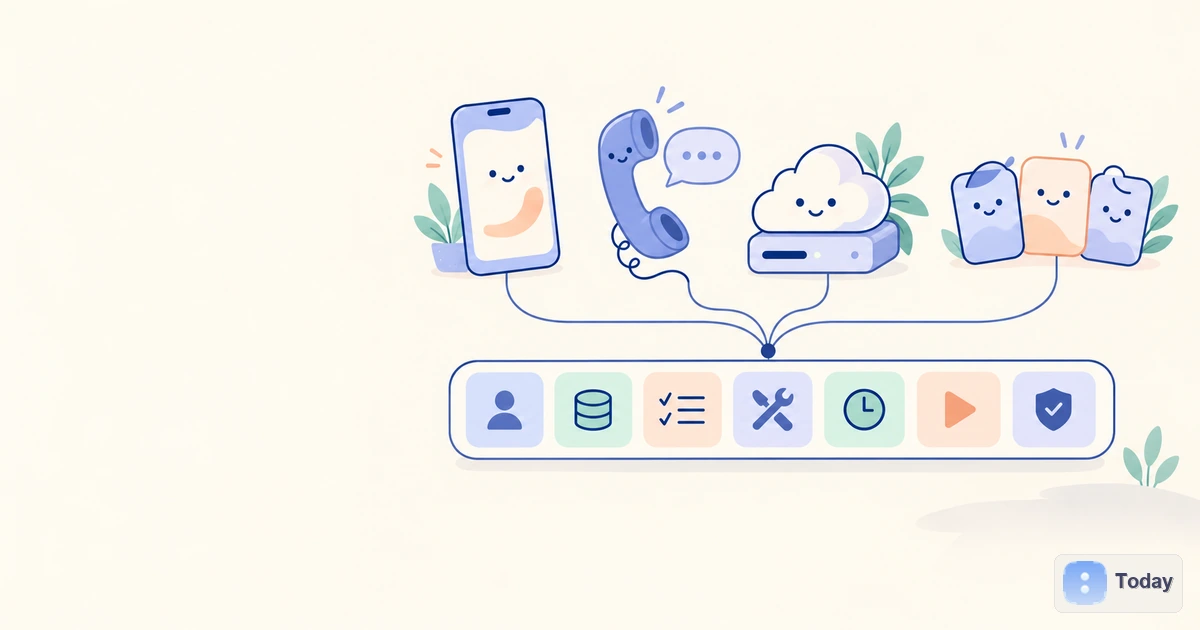
Put the products now called personal agents side by side and the category looks strangely inconsistent.
One is an app. Another asks you to text or call. One presents a single named assistant; another gives you a roster of bots. Some run on cloud computers, while another puts the agent on a dedicated Mac in your home or office. The category does not yet have a settled screen, device or organizational chart.
That does not mean the label is empty. The products are making different choices about where an agent lives and how a person encounters it, while converging on a similar functional problem: collect enough context to understand a person, retain what matters, plan across time and act through the systems that shape daily life.
This is a map of those choices. For the category definition itself, start with what an AI personal agent is.
Personal Agent Is Becoming a Category, Not an Interface
The first generation of consumer AI was easy to recognize: open a chat window, write a prompt, receive an answer. Personal agents are harder to identify by sight because the interface is no longer the product boundary.
Meta Muse is available through its own apps, the web and WhatsApp. It can keep working after the user closes the app and return when it needs approval. Instinct takes the opposite presentation: “no new interfaces,” just text or call it while it uses a phone and computer to handle tasks. OpenAI Dots can be reached through ChatGPT, Slack, Teams or a voice call.
Those are not cosmetic differences. The surface affects when the agent can reach you, which context it can see and whether using it feels like opening software, messaging a person or delegating to a colleague.
The better category test is behavioral. Does the system maintain continuity across time? Can it interpret a goal rather than only answer a prompt? Can it use tools or a computer to advance work? Does it preserve a meaningful boundary between proposing an action and committing it? A product can meet those tests without looking like a traditional assistant.
Six Choices Are Pulling the Products Apart
The current landscape becomes easier to understand when products are compared along six decisions rather than placed in one ranked list.
| Product decision | Routes emerging now | Why it changes the experience |
|---|---|---|
| Surface | App, web, text, phone call, chat platform, operating system | Determines how often the agent is present and how much new behavior the user must learn |
| Runtime | Cloud computer, remote browser, local device, dedicated always-on machine, hybrid | Determines what can persist, which apps are reachable and where sensitive state lives |
| Agent topology | One assistant, one primary agent with temporary subagents, stable team of named agents | Determines how tasks are divided and whether coordination is visible to the user |
| Identity | Acts as the user, acts as an assistant, or has its own colleague-like identity | Changes permissions, communication norms and accountability |
| Starting market | Everyday life, personal knowledge work, team operations, specialist domain | Shapes which context and tools matter first |
| Business model | Free tier, personal subscription, platform bundle, enterprise seat or usage pricing | Influences who controls deployment and who ultimately pays |
No row alone defines a personal agent. A WhatsApp surface can hide a sophisticated cloud runtime. A single character on screen can coordinate several models and subagents. A product sold to one person can still specialize in work, while an enterprise agent can learn an individual employee’s habits without becoming a whole-life personal agent.
The Runtime Is Splitting Into Cloud, Local and Hybrid Designs
Many new agents are getting a persistent place to work, but it is not always the same kind of place.
Muse runs on a dedicated secure virtual machine with its own browser. Dots has a cloud computer and can connect to thousands of apps through plugins. Grok Bot describes always-on agents working from a cloud computer. Google’s Gemini Tasks can use connected apps and websites, then run browser work locally or in a remote browser that continues after the user closes the device.
Perplexity Personal Computer is the useful counterexample. It uses a dedicated Mac mini that stays on, giving the system access to local files and native apps while Perplexity services help orchestrate the work. Persistence exists, but the machine is physically controlled by the user rather than living only in a vendor cloud.
So “every personal agent needs a cloud computer” is too narrow. The shared requirement is a persistent execution environment: somewhere to preserve files, sessions, tools, schedules and unfinished work. For a deeper explanation of that layer, see why AI agents are getting their own cloud computers.
One Assistant and Many Agents Can Be the Same Product Choice
The number of visible characters does not tell you how many agents are doing the work.
Dots launches with a primary dot and describes a future in which teams of specialist dots collaborate. Grok Bot makes the team more explicit: multiple always-on bots can divide work and pass context between one another. Gemini can present a single familiar surface while tasks, reusable skills and supporting execution systems handle different parts behind it.
These designs sit on a spectrum:
- One visible agent, one main process. The user delegates to one persistent assistant.
- One visible agent, dynamic specialists behind it. A primary agent decomposes work and invokes temporary subagents or tools.
- A visible team of agents. Named specialists have stable roles and may communicate with one another.
Multi-agent design is therefore not a requirement for a personal agent. It is an orchestration choice. The important user question is whether memory, permissions and responsibility remain coherent when work moves between agents.
There is also a category boundary worth protecting. Dots and Grok Bot demonstrate persistent and multi-agent patterns, but their launch examples lean toward projects, software and team operations. They sit closer to personal work agents or AI teammates than consumer agents for everyday life. The distinction matters; our comparison of personal agents and work agents treats scope as a product decision, not a naming contest.
Underneath the Different Forms, the Capability Loop Converges
The implementations vary, but the functional jobs look increasingly similar. Research on personal LLM agents identifies intent understanding, planning, tool use and personal-data management as central capability areas. Current products extend that foundation into a seven-part loop:
- Acquire context. Connect conversations, calendars, email, files, location or other signals the user chooses to share.
- Maintain durable memory. Separate lasting preferences, relationships and commitments from disposable task state.
- Understand intent. Infer the outcome behind an incomplete request without pretending uncertainty has disappeared.
- Plan the work. Break a goal into steps, choose tools and adapt when the environment changes.
- Use tools and computers. Work through APIs, browsers, native apps, terminals or combinations of them.
- Continue over time. Respond to schedules and events, preserve progress and resume after the user leaves.
- Return control. Ask for approval, expose activity, accept correction and let the user revoke access.
This is a functional architecture, not a claim that every vendor uses the same technical stack. A remote browser and a local Mac can both supply continuity. Structured memory and retrieval over conversation history can both support personalization, but they give users different levels of inspection and correction. One model may plan everything, while another product routes tasks across several models.
The common direction is more important than the implementation detail: the agent is becoming a continuing loop around a person, not a model waiting behind a blank prompt.
Context Is the Opportunity, and the Liability
Once capable models and tool use become widely available, product differentiation shifts toward harder questions. Which agent earns access to the richest useful context? Which one remembers accurately instead of accumulating stale assumptions? Which one can complete work reliably across messy applications? Which one makes permissions legible enough that the user remains willing to delegate?
This is our analysis of where the market is moving, not a settled industry result. Launch announcements describe intended capabilities; they do not provide long-term, independent proof that memory stays accurate or that complex tasks complete reliably.
The same stack that makes an agent useful also concentrates risk. Email and calendar expose relationships and routines. Persistent browser sessions hold credentials. A mistaken plan can become an external action. If several agents share context, one bad assumption can travel farther than it would in a single chat.
That is why control cannot be a settings page added later. Muse separates internet-bound actions through a Sentinel agent, asks before sensitive actions and exposes an audit trail. Gemini warns that browser tasks can share private information with websites and encounter malicious instructions. Different products will choose different safeguards, but the durable requirements are clear: scoped access, approval at consequential moments, visible activity, correction and revocation.
The Final Form Is Still Open
Personal agents are not converging on one app. They are converging on a job: understand enough of a person’s context to prepare useful judgment and carry work forward within boundaries that person can see and change.
The open questions are now product questions. Will the main agent live in an operating system, a messaging thread or dedicated hardware? Will people want one continuous persona or a team of specialists? When an agent contacts another person, will it speak as you or as itself? Will individuals pay directly, or will an employer or platform bundle the service?
Those answers may produce several durable categories rather than one winner. The useful way to evaluate them is not to ask whether they look like the assistant you already know. Ask where they live, what they remember, how they keep working, whose identity they use and where control returns to you.