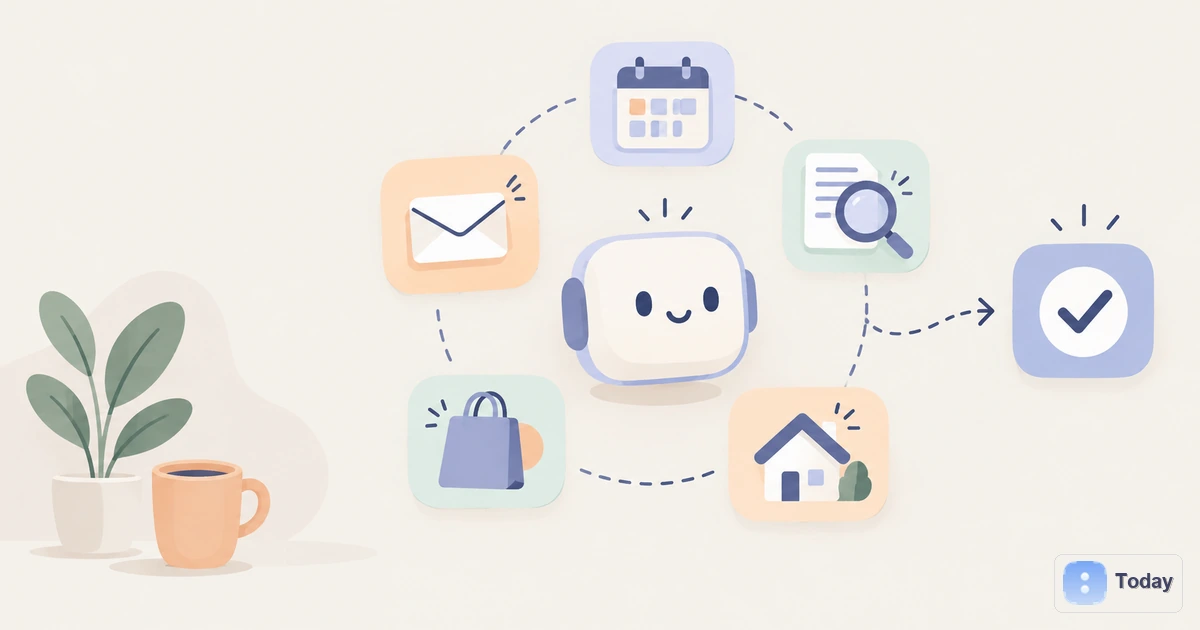
“What can a personal AI agent do?” often produces a list of features: browse the web, read email, make documents, use apps. Features describe the toolbox. A useful use case describes the finished job.
An agentic task has a goal, a sequence of actions and a way to know when it is done. It may cross several tools, wait for another person or return after new information arrives. That is why “summarize this message” is a prompt, while “keep track of this conversation, prepare my replies and remind me if it stalls” is an agent use case.
The following examples focus on work a person can actually hand off—not imaginary total autonomy.
Before the List: A Five-Part Test for Agent Work
A task is a strong candidate when most of these statements are true:
- The finish line is visible. You can tell whether the reservation was made, the brief arrived or the follow-up was prepared.
- The work has several steps. The task requires gathering context, choosing a path, using a tool or returning later.
- The inputs are accessible. The agent can reach the relevant files, messages, calendar or websites with permission.
- Mistakes are reviewable or reversible. A person can inspect a draft, cancel an action or correct a record.
- The task repeats or carries forward. Memory and follow-up remove real effort rather than adding setup for a one-off answer.
If the goal is vague, the action is irreversible and nobody can verify success, automation is not maturity. It is unbounded risk.
1. Build a Daily Brief That Changes With the Day
A personal agent can combine today’s calendar, important messages, deadlines and ongoing goals into one brief. The useful version does more than list events. It identifies preparation work, flags conflicts and updates the plan when a meeting moves.
Input: calendar, selected inboxes, tasks and personal priorities. Agent work: gather changes, rank what needs attention and prepare context for the next event. Approval boundary: schedule changes or messages to other people. Output: a short plan that remains current instead of a static morning summary.
Town offers daily briefings and automatic meeting preparation as routines. Muse describes family calendars and goal tracking. Today uses the Morning Brief as one expression of a broader personal agent, not as the whole product.
2. Turn the Inbox Into a Follow-Up System
Email triage becomes agentic when it continues beyond categorization.
The agent can identify messages that need a reply, retrieve the relevant document, draft in the user’s preferred style, record who is waiting on whom and return when a deadline passes. Sending remains a separate permission from reading or drafting.
This use case is especially valuable for conversations that disappear after the first reply: introductions, invoices, applications, approvals and scheduling threads. The output is not an “inbox zero” score. It is a reliable list of commitments and next actions.
3. Monitor a Topic Until Something Actually Changes
One research report answers what was known at a moment in time. A research agent can watch the topic and report only material changes.
Examples include:
- a competitor ships a relevant feature;
- a regulation or application deadline changes;
- a product returns to stock or crosses a target price;
- a company publishes a filing;
- a source corrects an earlier claim.
The user should define what counts as material, how often the agent checks and whether the output needs primary sources. Without that threshold, “keep me updated” becomes an expensive stream of noise.
4. Prepare Decisions Without Pretending to Make Them
Travel, purchases and service choices often require research across many sites. An agent can collect constraints, compare realistic options, expose tradeoffs and keep the shortlist current.
It should not hide judgment behind one confident recommendation. A good deliverable states why an option was excluded, which price or policy may change and what still needs the user’s preference. The decision remains personal; the search and reconciliation do not have to be.
Manus publishes examples including travel planning and policy comparison. Muse lists budgeting, trip booking, gift ideas and shopping among its everyday tasks.
5. Coordinate Meetings Before and After the Call
Transcription captures what was said. An agent can connect the meeting to the work around it.
Before the call, it can retrieve the last discussion, open commitments and relevant documents. Afterward, it can separate decisions from ideas, draft the follow-up, create tasks and check before the next meeting whether promised work arrived.
This is a good example of why personal context matters. The same sentence can be an action, a tentative thought or a reference to an old decision. An agent that knows the project history can classify it more carefully than a generic recorder, while still asking when the evidence is ambiguous.
6. Carry a Long-Term Project Across Interrupted Weeks
Writers, researchers, founders, students and job seekers rarely finish in one session. They accumulate sources, reject options, change direction and forget why a decision was made.
A personal agent can maintain the project thread: current objective, confirmed facts, discarded paths, unresolved questions and the next useful action. When the user returns, it resumes from the decision state rather than offering another generic plan.
This is different from storing every conversation. Useful memory is selective and correctable. The user needs to inspect what the agent believes, remove a bad assumption and distinguish a durable decision from a temporary idea. For the category foundations, see what an AI personal agent is.
7. Produce a Content or Creative Deliverable End to End
An agent can turn a brief into a research pack, outline, draft, visual direction and publication checklist. The final result may be an article, presentation, campaign concept, video plan or simple website.
The work becomes agentic when the system manages dependencies and revisions rather than generating one asset. It checks source claims, preserves brand requirements, asks for a decision when two directions diverge and returns a complete package for review.
Human authorship still matters. An agent may organize evidence and develop language, but it must not invent the author’s experience, customer results or personal opinion. Approval should cover both factual accuracy and the judgment being published under someone’s name.
8. Reproduce a Bug and Prepare the Fix
Software work provides unusually clear completion conditions. Given a report, an agent can reproduce the behavior, collect logs, identify a likely cause, modify code, run tests and prepare a pull request.
OpenAI describes dots scoping fixes, building, testing and bringing back PRs. Grok Bot documents bug reproduction as a role that can be taught and repeated. A persistent environment helps because dependencies, browser state and artifacts survive across review rounds.
Production deployment should remain a separate authority. Passing tests are evidence, not permission to change a live system.
9. Handle the Repetitive Back Office of a Small Business
Small businesses contain many bounded workflows that are important but easy to neglect:
- prepare invoices and check whether they were paid;
- research a lead before outreach;
- update a CRM from a meeting;
- monitor account health or ad performance;
- assemble a weekly operations packet;
- draft customer responses using order or account context.
OpenAI’s launch example includes a dot noticing a forgotten invoice, preparing it and sending after approval. Grok Bot publishes sales outbound and account-health roles. These examples share a useful boundary: the agent prepares evidence and action; the owner controls commitments, pricing and sensitive communication.
10. Coordinate Household Logistics
Household work is fragmented across calendars, messages, school notices, shopping lists and recurring services. A personal agent can assemble the shared picture and surface the few conflicts that need a person.
It might propose a grocery order based on the week’s schedule, remind the family about a form, coordinate a repair appointment or keep track of an event plan. The hard part is not generating a list. It is respecting that several people have different preferences, privacy and authority.
The agent should state whose information it used and avoid treating one family member’s access as permission to disclose another’s data.
11. Manage Bookings, Queues and Purchases With a Stop Before Payment
Personal agents can search availability, fill forms, hold a place in a queue and prepare a checkout. Cue describes agents ordering after a restaurant QR scan or waiting in line; Muse advertises reservations, travel booking and shopping.
This is where a polished demo can conceal the most risk. Prices change, cancellation terms vary, identity checks fail and merchants make mistakes. The safe workflow separates stages:
- search and compare;
- prepare the chosen transaction;
- show the final price, terms and recipient;
- obtain approval;
- complete the action and return a receipt.
A spending cap limits the size of a mistake. It does not decide whether the transaction was appropriate.
12. Coordinate Several Specialist Agents
A single personal agent does not have to perform every step itself. It can assign research, analysis or production to specialist agents and bring the results back to one decision point.
Cue illustrates several agents handing off work in a group chat. Grok Bot similarly supports collaboration between Bots on a shared cloud computer. The useful pattern is not a cast of personalities. It is explicit ownership: who is responsible for the source packet, shortlist, draft, review and final handoff.
Multi-agent work needs stronger provenance, not less. A polished final deck should still reveal which evidence was used and which assumptions remain unresolved.
A Five-Level Path From Help to Autonomy
The same use case can be safe or reckless depending on the permission level.
| Level | Agent responsibility | Suitable starting examples |
|---|---|---|
| 1. Read | Gather and summarize authorized information | Daily brief, meeting context, monitoring report |
| 2. Prepare | Create a draft, plan or shortlist | Email draft, trip comparison, invoice draft |
| 3. Act with approval | Pause before a consequential external action | Send, book, purchase, publish |
| 4. Run a bounded routine | Repeat low-risk work within explicit rules | Weekly report, CRM hygiene, price alert |
| 5. Coordinate | Delegate among agents while a person controls the goal | Research-to-deck workflow, multi-step project support |
Products often market Level 5. Most users should begin at Level 1 or 2. Reliability should be demonstrated on the exact workflow before authority expands.
Work That Should Stay Human
Some tasks can use agent assistance without becoming agent-owned.
Medical, legal and financial decisions require qualified judgment and accountability. Sensitive relationship conversations depend on intent and empathy that cannot be reduced to an optimized reply. Large purchases, destructive account changes and public statements carry consequences that may not be reversible.
An agent can gather records, explain options, prepare questions and identify missing information. It should not quietly become the decision-maker because the interface made delegation easy.
Pick One Use Case by Looking for Friction, Not Novelty
The best first task is rarely the most dramatic. Look for something that recurs every week, crosses two or three sources, has a clear output and currently fails because someone forgets the follow-up.
Then narrow it: one inbox, one type of meeting, one project or one monitoring threshold. Let the agent read and prepare. Inspect the result. Only add external action after the system behaves predictably when information is missing or circumstances change.
That is the real promise of a personal agent. It does not replace responsibility. It keeps the thread, does the legwork and brings the next meaningful decision back to you.