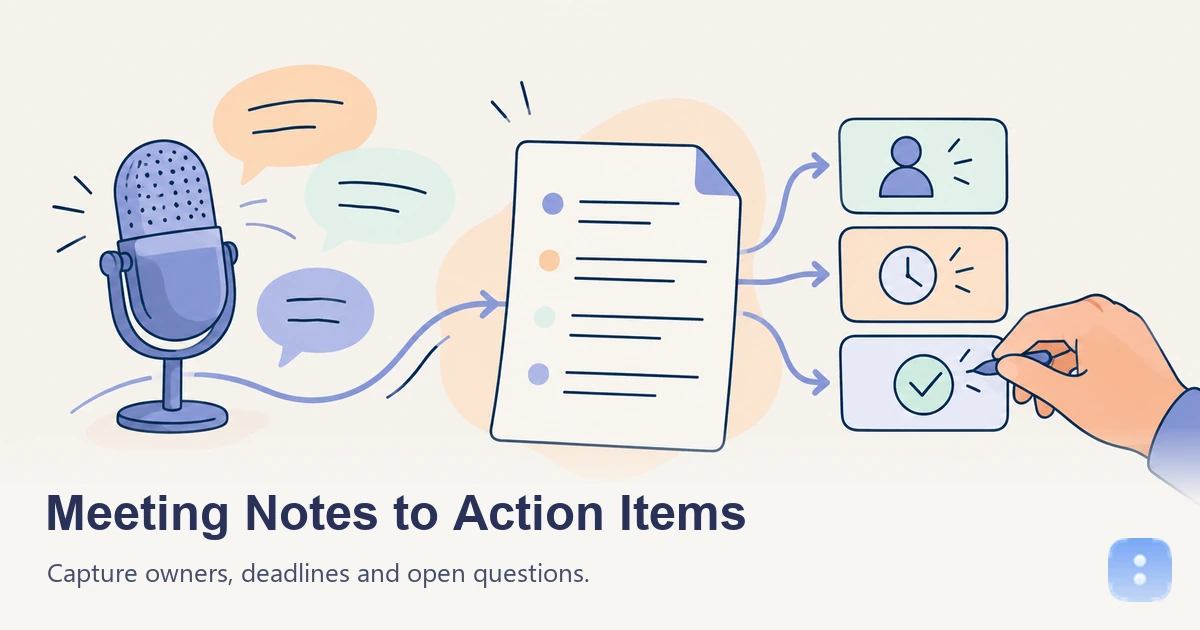
Turning meeting notes into action items requires a judgment that a summary can easily hide: did someone actually agree to do the work? “We should update the proposal” is an idea. “I'll update the proposal by Thursday” is a commitment. A useful follow-up preserves that difference.
AI can help extract candidate actions, find the supporting lines and draft the message that closes the meeting. You still need to resolve unclear owners and deadlines before presenting the list as agreed work. This guide demonstrates that process with a fictional transcript, not a customer recording or a product test.
Start With What Was Actually Said
Consider this excerpt from an imaginary project review held on Tuesday, October 6, 2026:
Maya: I'll send the revised landing-page copy by Thursday at noon, London time. Leo: I can review it Friday morning if the copy is ready. Maya: That works. Let's use your comments to prepare Monday's review. Sam: We should probably add a customer quote to the page. Maya: Maybe. We need permission to use it first. Who can check? Sam: I'm not sure. Let's ask Nina. Leo: And are we still launching on the twelfth? Maya: No launch date is confirmed. Monday is a review, not a release.
There is enough here to create useful follow-up, but not enough to assign every piece of work. In particular, Nina has not accepted anything, the customer quote is not approved and Monday is not a launch deadline.
If a transcript is unclear at one of these points, return to the recording or ask a participant. Polishing uncertain words into a more decisive sentence makes the notes less reliable. Our guide to meeting transcription accuracy explains why errors in names and other critical details deserve review even when the transcript reads fluently.
Prior project context can explain which page or review people mean, but it cannot replace evidence from this meeting. An old assignment does not prove someone accepted a new task, and an earlier launch plan does not override the explicit statement here that the launch date is unconfirmed.
Classify Before Assigning
Ask the assistant to separate accepted commitments, conditional commitments, suggestions and unresolved questions. Keep evidence beside the classification so you can review the decision instead of retracing the whole meeting.
| Item | Status supported by the excerpt | What can be recorded |
|---|---|---|
| Revised landing-page copy | Accepted commitment | Maya; Thursday, October 8, noon, Europe/London |
| Copy review | Conditional commitment | Leo; Friday morning, if the copy is ready; exact time not stated |
| Add a customer quote | Suggestion | Needs permission and a decision before becoming agreed scope |
| Ask Nina about permission | Proposed next step | No confirmed owner or deadline; Nina has not accepted the work |
| Launch on October 12 | Not confirmed | Monday is a review; launch date remains open |
The table does not turn every row into a task. That restraint is the point. A task list with invented ownership creates confusion precisely because it looks more complete than the conversation was.
Dates deserve the same care. The meeting date lets us resolve “Thursday” to October 8, but “Friday morning” still lacks an exact time. If the meeting date or speaker's time zone is unknown, leave the date unresolved until someone confirms it. Do not manufacture precision simply because the destination task form requires a timestamp.
Write Actions That Have a Checkable Result
An action item should describe the deliverable, owner and due point, together with any dependency. For Maya, that becomes: “Send revised landing-page copy by October 8 at 12:00 Europe/London.” For Leo, keep the dependency: “Review the copy Friday morning, provided Maya's draft is ready.”
Avoid expanding “send revised copy” into “publish the new page.” Those are different results with different consequences. Likewise, a person being mentioned is not evidence that they own the work. “Ask Nina” and “Nina will obtain permission” cannot be substituted for each other.
A practical request to the assistant is:
Use these meeting notes to identify commitments. For each one, give the deliverable, accepted owner, deadline as stated, dependency and supporting passage. Separate suggestions and open questions. Mark missing details rather than filling them in. Do not create tasks, send messages or treat proposed owners as confirmed.
The result is a review sheet. After checking it, you can decide which items belong in your own task system, which need confirmation and which should remain part of the meeting record.
Draft a Follow-Up That Invites Corrections
The follow-up message should make the confirmed work easy to see and ask only the questions that are still necessary. Here is an illustrative draft based on the excerpt:
Subject: Landing-page review — next steps and one open question Thanks, everyone. Maya will send the revised copy by Thursday, October 8, at noon London time. Leo will review it Friday morning if the copy is ready, with comments feeding into Monday's review. The customer quote remains a proposal. We still need to confirm who will ask Nina about permission before it becomes part of the page scope. Could someone take that follow-up? Monday, October 12, is the review date; no launch date was confirmed. Please flag anything I've misunderstood.
This message does not quietly assign the permission request to Sam or Nina. It also avoids a false deadline for Leo. If the exact review time matters to your plan, ask Leo directly rather than hiding an invented time in the recap.
Check recipients and remove material they should not receive before sending. A complete internal transcript and a concise external follow-up can have very different audiences. Preparing the draft is not permission to distribute the underlying recording or every detail discussed.
Carry Unfinished Work Into the Next Meeting
Before the next review, compare the accepted commitments with new evidence: the delivered draft, a reply confirming permission or a participant's update. Keep the original commitment alongside its current status so that a changed plan is understandable.
If the copy has arrived, the preparation note can link to it. If no update is available, say “completion not verified” rather than assuming failure. If the deadline changed by agreement, preserve the new date and where that agreement was recorded. A useful carry-forward note makes three states easy to distinguish: completed with evidence, changed by agreement and still waiting for an update.
Do not carry every old suggestion forever. The customer quote might be declined or postponed. Once that decision is confirmed, remove it from the active questions while leaving the meeting history intact. Otherwise the assistant can keep resurfacing an idea that the people involved already settled.
Using Today Recording for This Follow-Up
Today Recording keeps context-aware notes and lets you continue asking questions after the meeting. Once you have reviewed the recording or transcript, you can ask for the commitment breakdown or a follow-up draft described here. These are explicit follow-up requests, not a claim that Today automatically extracts tasks, assigns owners or sends the recap after every recording.
Use only recordings and notes you are authorized to capture and share. Keep uncertain names, statements and relationships uncertain until you can confirm them. For product-specific behavior, the Today Recording introduction explains the recording-to-conversation flow.
The meeting is ready to hand off when the accepted commitments are accurate, the open questions are visible and each recipient knows what still needs confirmation. A shorter, honest list is more useful than a complete-looking set of tasks nobody agreed to do.