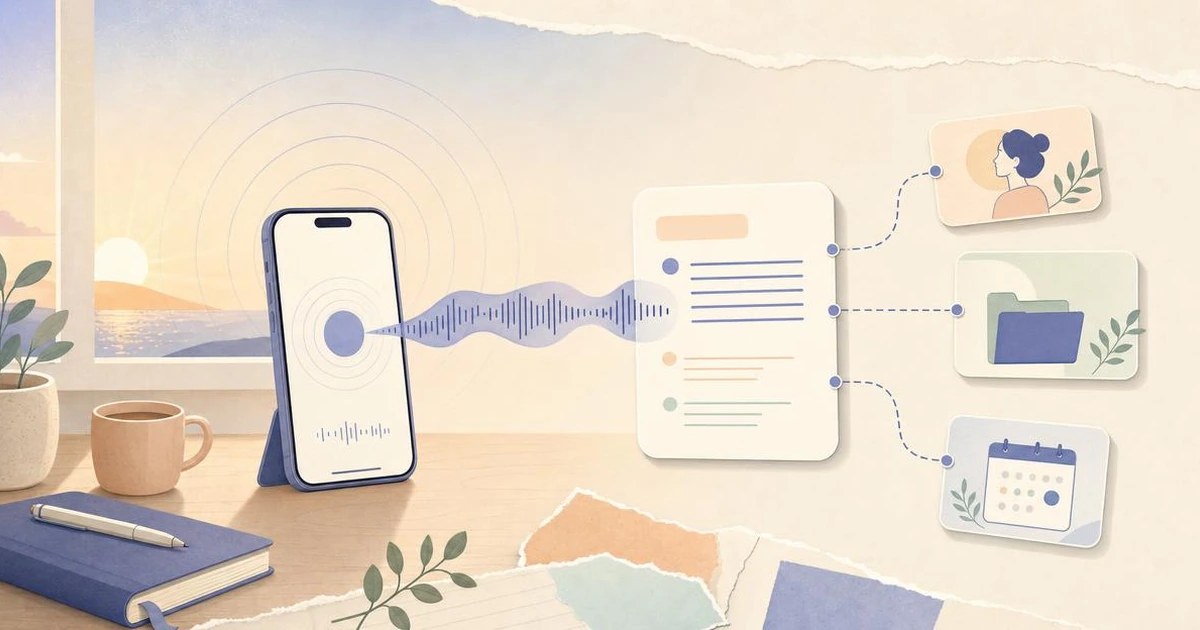
A meeting never happens in isolation. It lands in the middle of a project that has been running for months, among people who carry roles and histories, on top of decisions made last week in a room you were not in. When we started building Today Recording, we kept returning to one gap: the tools that record meetings have gotten good at hearing words, and they remain bad at knowing what the words refer to. So we built the recorder we wanted for our own mornings — one that starts from your calendar, listens alongside your memory, and hands you a summary you can act on without re-explaining a thing.
A Meeting Never Happens Alone
Somewhere in your most recent recording, someone probably said something like this. "Let's keep Launch on the plan we already agreed to." Or: "Sunhao takes the next pass." Or, briskly, near the end: "We're holding voice ID for now — the release moves out a week."
A transcript captures those sentences perfectly. It can even punctuate them beautifully. And yet, read cold, they point at nothing in particular. Which plan, agreed to when and by whom? Who is Sunhao, and what exactly is he taking a pass at? Holding voice ID relative to what expectation, and delayed from which date? The words are all there; the meaning stayed in the room.
To be fair, the category has not been standing still. Most meeting-notes apps already promise real-time transcription, speaker labels and calendar sync across the usual video-call tools, with a recap that lands in Slack or your inbox minutes after everyone leaves. Many go further: action items filed as tasks on their own, transcripts ready to pour into a brief or a product doc, a searchable archive of every conversation you have ever had. By now that is the baseline rather than the frontier — table stakes, not the winning hand.
And underneath all of that machinery sits the same quiet failure. You receive a document that is fluent, well organized and strangely generic — a summary that could describe anyone's meeting, delivered to the one person for whom it was supposed to remove work. Transcription, distribution and search all assume the note already knows what it is about. It does not. Before you can act on it, you end up reconstructing the context yourself: which project this touches, who that person is, what was already decided. Then you paste the whole thing into a different AI assistant and brief it on your situation, just to climb back to where you already stood when the meeting ended. The meeting produced decisions; the notes produced homework.
We think a recorder can do better, and the reason it can is already sitting inside Today. If you use Today, it holds a living memory of your work — the projects you are pushing, the people you build with, the decisions on the books and the questions still open. Today Recording is simply what happens when that memory is in the room while you talk.
What Today Recording Is
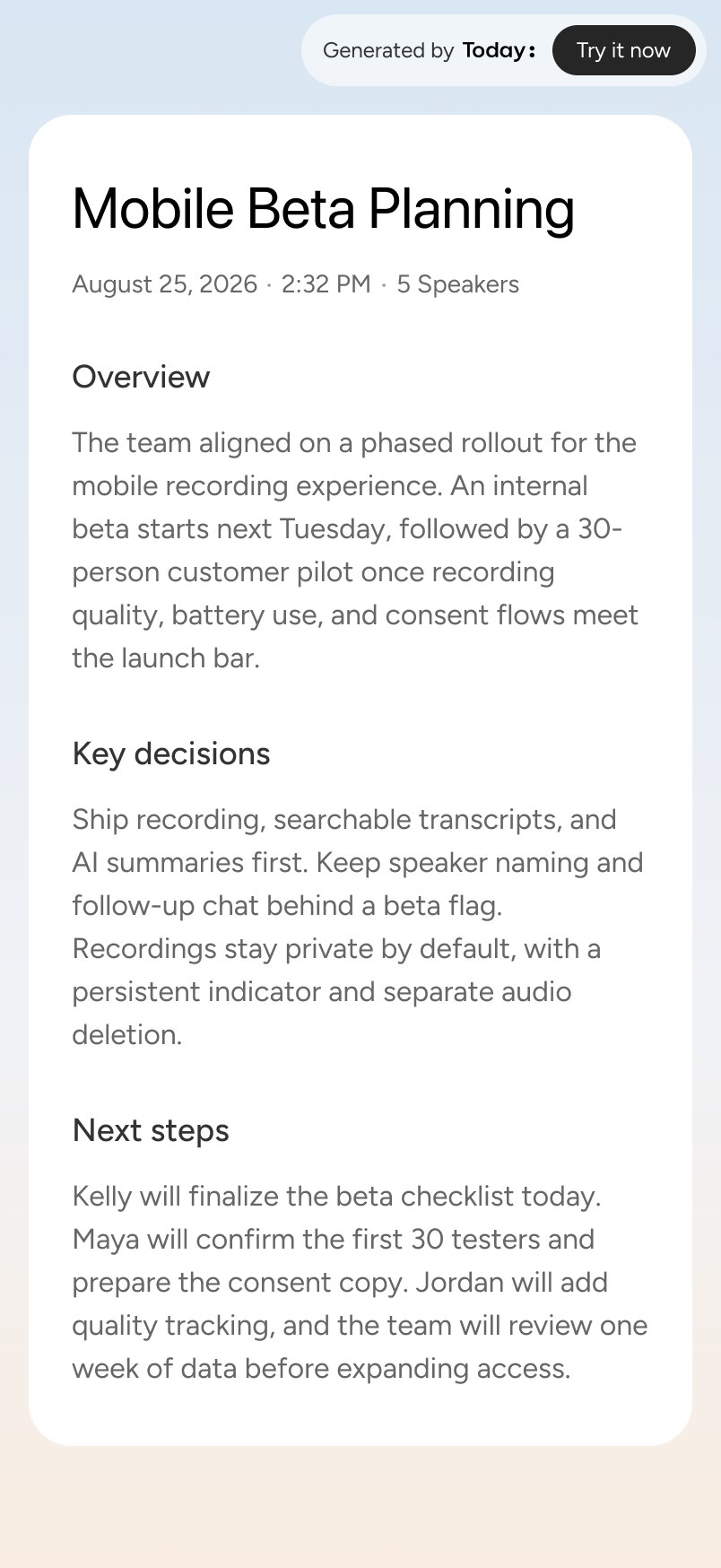
Today Recording is meeting recording built into Today, and it is organized around one idea: a meeting summary should not merely record what was said — it should know what you were talking about. When you record a conversation, Today reads it against the memory you have already built and writes a Summary that names the actual project, the actual people and what actually changed. Where a generic note reports that the team "discussed the launch schedule," Today can say which launch, which schedule, and which part of it moved.
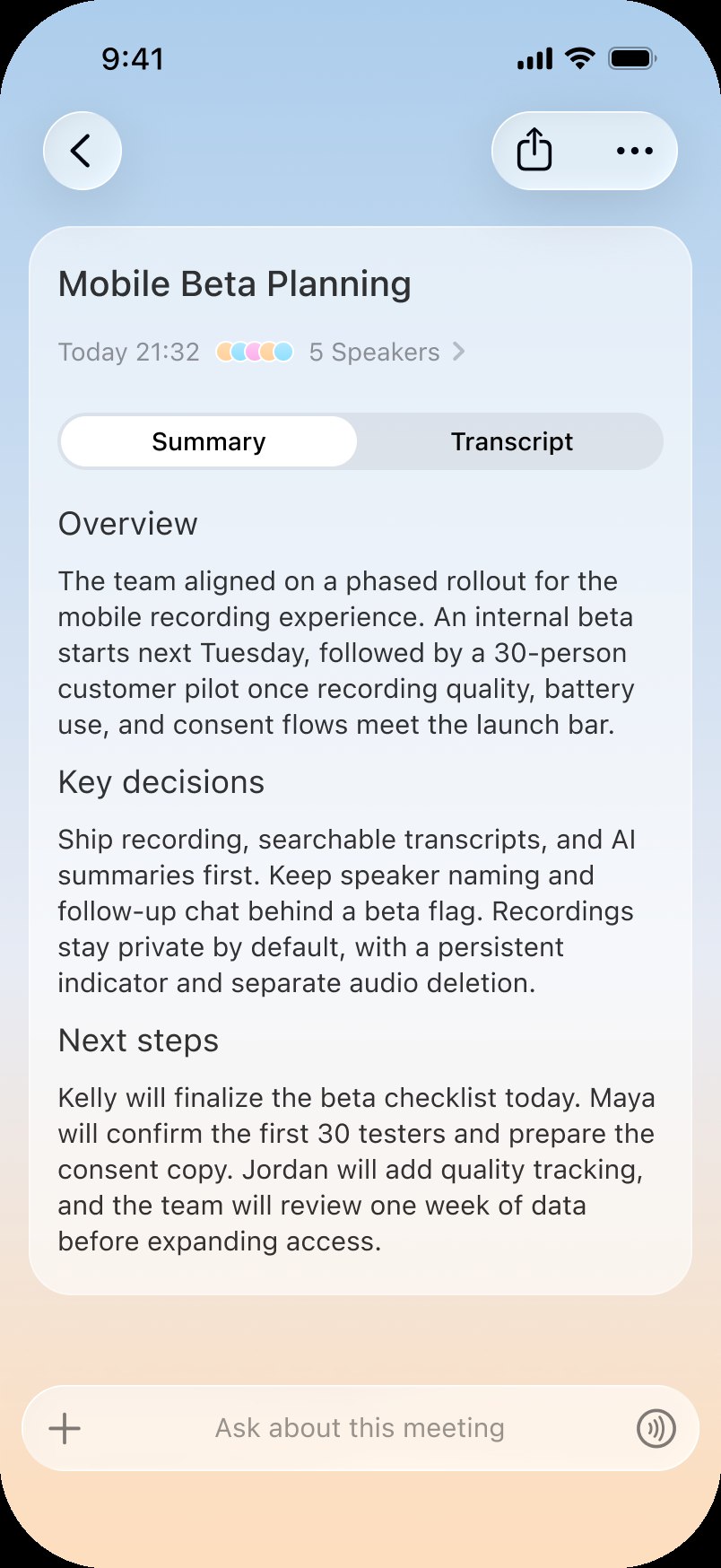
Recording itself arrives first on Mac and iPhone. The Summary it produces, and the conversation that follows, live in Today — which means they are with you on every platform Today runs on. Record from your phone in a conference room, read the Summary later at your desk, ask a follow-up question from the train home. The recording starts on two devices; the work continues wherever you are.
If you are new to Today, the short version is that it is an AI personal agent that keeps a living memory of your work and your life and acts on it with your approval — the longer version lives in what Today is. If you are new to the category itself, our guide to what an AI personal agent is walks through the ideas — memory, initiative, execution — that this recorder leans on. Neither article is required reading. You need a calendar, and a conversation worth keeping.
The Chain: From Calendar Alert to Follow-Up Question
The easiest recording to lose is the one you forgot to start, so the chain begins before the meeting does. Today connects to your calendar and notices when a conversation is about to begin. A Live Activity appears on your lock screen asking whether you want to record, and one tap starts it. You did not have to remember anything, hunt for an app, or keep the room waiting while you set things up.
Once the conversation is captured, the transcript is raw material rather than the product. The next link is memory: Today reads the recording against what it already knows about you — the projects in motion, the people on the team, the decisions already made, the questions you have been carrying. That is what allows the Summary to be specific instead of merely tidy. It can write "the Atlas launch," not "a product launch"; "Priya, who owns pricing," not "a participant"; "this revisits the call from last month," not "a decision was reached."
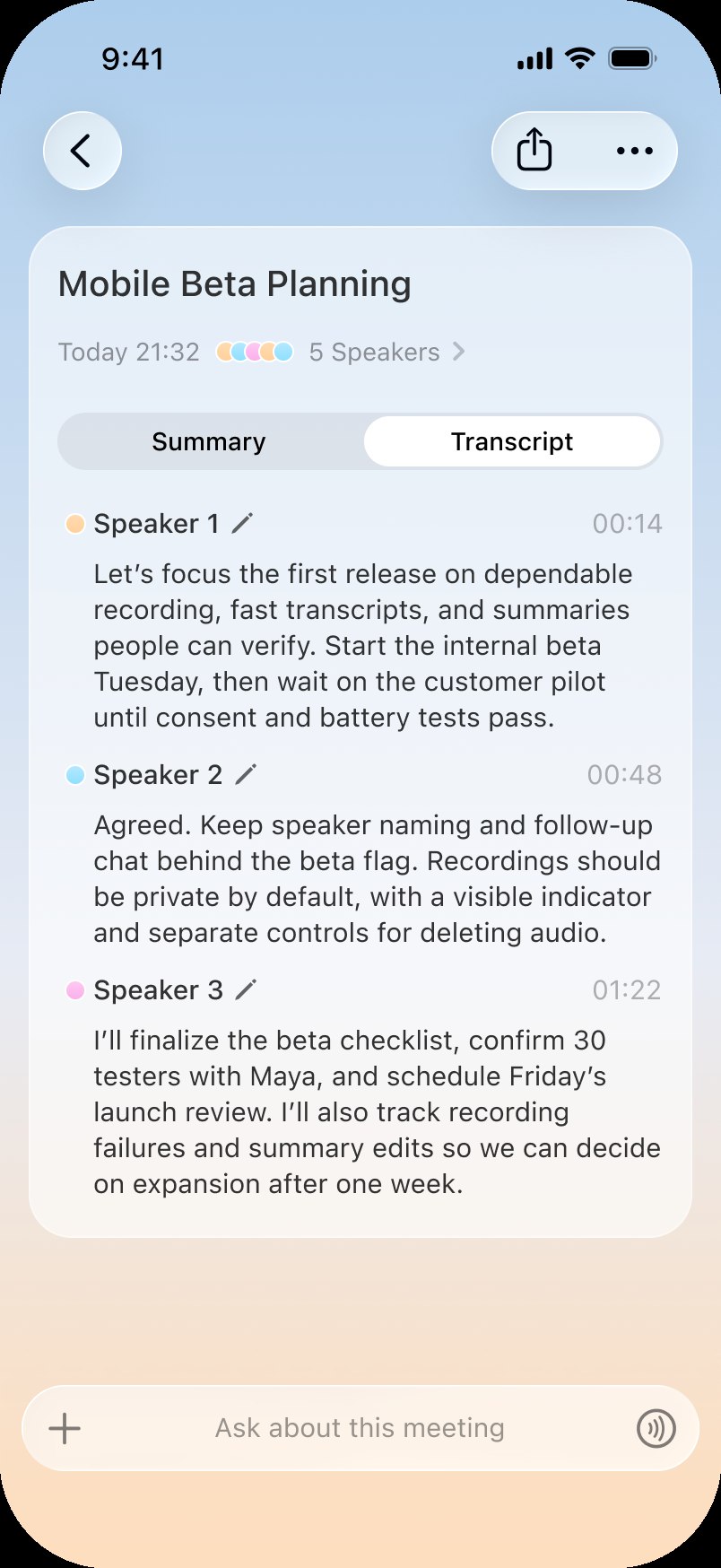
The Summary is the first thing you see, but we designed it as a beginning rather than an ending. It closes by pointing forward — what was decided, what remains unresolved, what follows from here. And because the meeting lives inside Today, you can keep talking to it: ask why a decision went the way it went, ask what is still open, ask for the rest of your week rearranged around what just changed. One chain, end to end — calendar, recording, memory, Summary, follow-up. No export, no re-briefing, no second tool in between.
What Memory Changes About a Summary
The difference shows up fastest in meetings that repeat. Suppose you run a launch review every week: same project, same people, a rolling set of decisions. A standalone recorder, hearing only this week's call, will faithfully produce something like — the team discussed the release schedule; some features will ship this week; another was delayed for further testing — and then file that recap wherever it files recaps, satisfied with a job well done. Every word accurate. Every referent missing. You know which launch it means; the note does not; and a month from now, neither will you.
Today, reading the same recording against memory, can write the same meeting differently: this week the launch ships the new Summary experience and the calendar Live Activity, while speaker recognition finishes development and heads into internal testing before any release decision is made. The note names the project it belongs to, the people who own each piece, and what changed relative to the last review. You never have to re-explain what the launch is, what the Summary refers to, or which feature slipped. The summary already knows, because Today does.
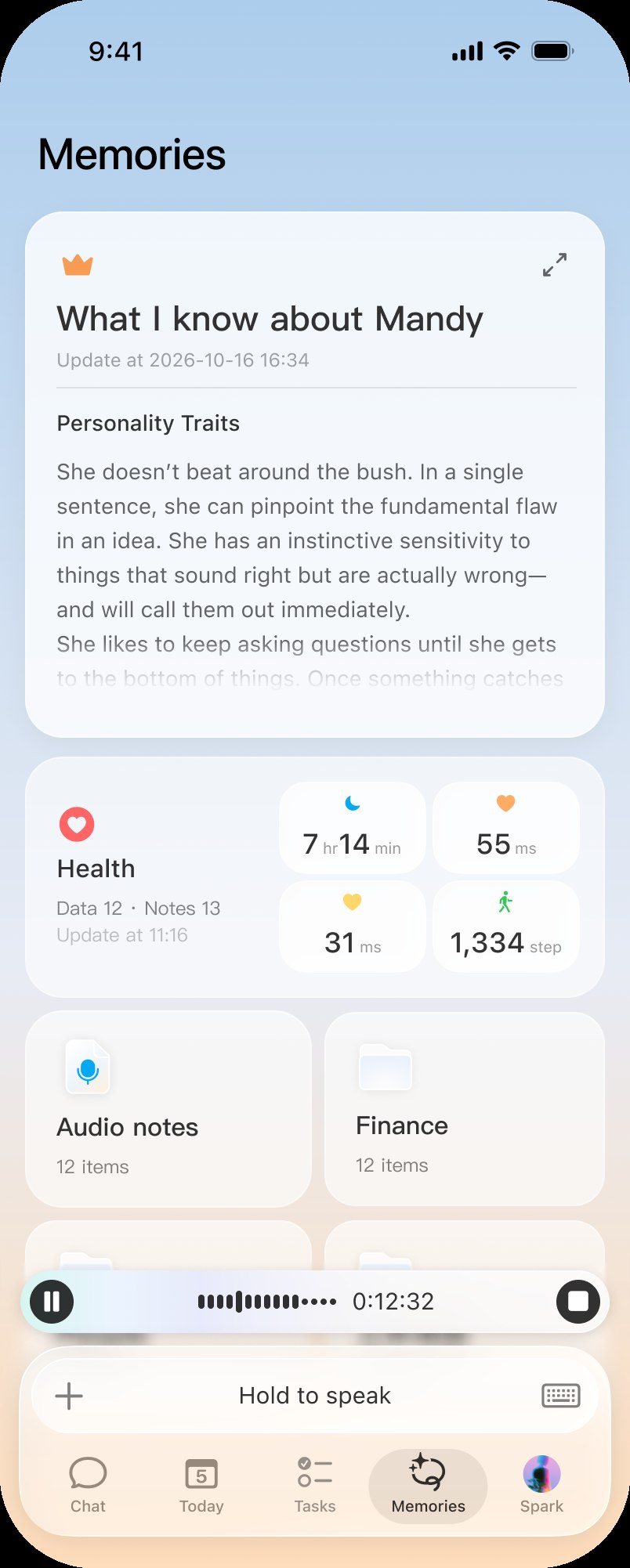
The second thing memory changes is how meetings accumulate, and this one matters even more. Decisions get revised in real projects. The first review says the new Summary and speaker recognition both ship this week; the next one says the Summary ships as planned, while speaker recognition holds for another round of internal testing. Two recordings, and in most tools, two documents that quietly contradict each other. Today keeps both conversations attached to the same project and treats the most recent confirmed decision as the current state. Ask later what the release plan actually is, and you get today's answer, with the history of how the plan got there if you want it.
That last point is worth slowing down on. A recorder that does not know you treats every meeting as an isolated artifact, and your project slowly turns into an archive. A recorder that does know you treats every meeting as an update — the newest information about work that is still in motion. The pile stops growing in quite the same way, because the context is being maintained rather than merely accumulated.
Keep Asking After the Meeting Ends
A summary, however good, is a snapshot; your work is a film. The honest test of a meeting tool is what happens the moment you finish reading, because that is exactly when the new questions arrive. In most setups, this is where you leave: you copy the notes into another window and spend the first half of the exchange explaining your project to an AI that has never heard of it. Today Recording keeps you where you already are. The meeting, the Summary and the memory occupy the same place, so the questions you actually have can simply be asked.
Why was speaker recognition pushed by a week — what reason was given, and who argued for waiting? Which issues surfaced in that room that are still unresolved now? Could you take this meeting and turn it into a plan for the rest of the week, next steps first? None of these require exporting a transcript or rebuilding context from scratch. You ask in the same thread where the recording lives, and the answers come back grounded in what was actually said rather than in a guess about what your project probably is.
This is where the Summary stops being the end of a recording and becomes the start of your next block of work. The recording captured the conversation; the memory knows what it connects to; the follow-up turns both into motion. The pattern we notice in daily use is consistent: people open the Summary to check it — and stay for the questions they did not know they could ask.
It Shows Up When You Need It
The chain begins with knowing that a meeting is coming, and that matters more than it sounds. The most common failure in recording is not bad audio; it is the meeting you meant to record and did not. You walk in with coffee, the discussion starts, and partway through you realize the recorder is on the wrong device — or on no device at all. Today moves that decision to the moment you can still make it: a Live Activity on your lock screen, shortly before the meeting, asking if you want to record.
To be clear about what this is not: it is not automatic recording. Nothing records without your tap, every single time. The Live Activity is an offer rather than an obligation — decline it, and Today simply waits for the next meeting. We think of it as the recorder carrying the quality we want everywhere in Today: it knows your day well enough to show up at the right moment, and respects you enough to ask first.
There is a quieter benefit, too. Meetings that were too small to justify the ceremony of recording — the brief client call, the ad-hoc sync — become worth capturing, because starting costs one tap at a moment when you are already looking at your phone. The barrier was never really the technology. It was everything wrapped around it.
What We Don't Claim — Yet
A tool that sits in your meetings earns trust by being precise about its boundaries, so here are ours. First, memory informs the Summary; it never overrides the recording. The conversation is the record of fact, and memory supplies the context around it. When a name, a decision or a relationship cannot be resolved with confidence, Today keeps the uncertainty instead of smoothing it into a confident-sounding guess. A summary that invents a referent is worse than one that admits it is unsure.
Second, on transcription quality: we measure it in the open, not in adjectives. Our latest evaluation took five and a half hours of overlapped multi-speaker meetings from a public benchmark and ran a four-way comparison — Today's full transcription pipeline against the raw output of three speech providers — and speaker-attribution error dropped by more than four percentage points while text error held steady. The benchmark, the scoring tool and every test condition are published in meeting transcription accuracy, alongside what makes a transcript trustworthy and how to read the accuracy claims this category likes to make.
Third, speaker recognition — knowing who is talking by voice — is in internal testing. It is not part of what is available today, and we are not attaching a date to it. We would rather ship the parts that work than promise the parts that might.
Finally, on what happens after the notes land: some tools in this category will already file action items as tasks and draft the follow-up for you. Today does not yet turn your meetings into automatic action suggestions. What it does today is what this post describes: a Summary that knows its context, and answers to the questions you ask about it. What to do next remains your call — with Today helping when asked, the way it always has.
Who It's For
The people who get the most out of Today Recording tend to share one circumstance: their meetings repeat, and the decisions in them pile up. If you run product reviews, you know the meeting where half the room was fully present and half was not — the engineers who dialed in before sunrise and the designer for whom it was nearly midnight. The Summary lands attached to the project already in memory, so whoever missed the room can still see what moved, and who owns what moved.
If your afternoons disappear into back-to-back interviews, each conversation stays attached to its role and its panel, which keeps the debrief honest: comparable notes side by side, rather than a stack of impressions that all blur together by the end of the day. If a client call owes a follow-up by tonight, the Summary separates what was committed from what stayed open, and the message you owe can be drafted without leaving Today. And if you sit in the weekly sync where decisions keep reversing, the most recent confirmed decision stands as the current state, while the path it took to get there stays visible — reversals become traceable instead of merely confusing.
Notice what these situations have in common. In each one, the meeting is only worth recording because of what surrounds it — the project, the role, the promise, the history. A tool that records without knowing any of that can still give you words. Only a tool that knows you can give you the meeting.
Conclusion
Most recording tools get to ask a narrow question: what was said? Today Recording gets to ask a wider one, because it already knows you: what does this mean for the work in front of you, and where do you pick it up? That is the whole difference — other tools summarize a meeting; Today understands what the meeting means in your work, and lets you continue directly from it. The calendar tells Today a conversation is coming, one tap captures it, memory explains what it touches, the Summary names it all, and the follow-up carries it forward. Connect your calendar, and record the next conversation that matters — get started with Today.