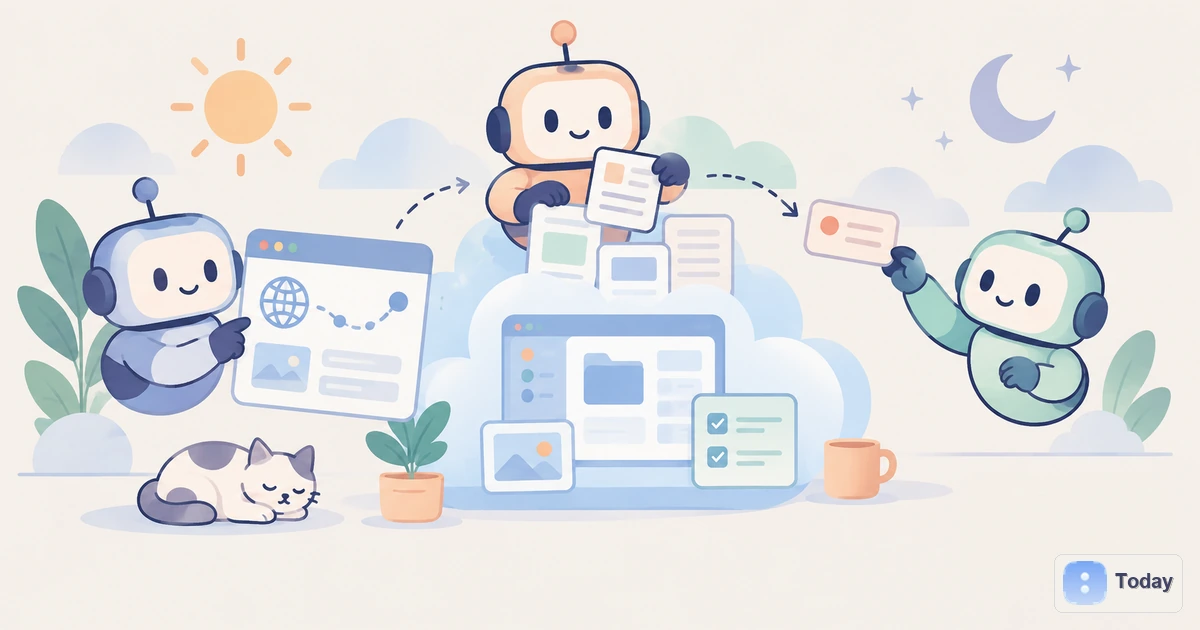
Most AI products still organize work around a session: open a chat, explain the task, watch it run, then start over somewhere else. Grok Bot changes the object in the sidebar. Instead of a list of disposable conversations, it gives you a roster of named teammates that keep their context, computer and responsibilities.
That sounds similar to every promise of an “AI employee,” but xAI has shipped enough concrete product structure to make the distinction useful. A Bot has a persistent cloud computer, can sign into real tools, can learn a repeated workflow by watching you, and can coordinate with other Bots. The harder question is whether that structure remains reliable, governable and economical after the launch demo.
What Grok Bot Is
xAI introduced Grok Bot on August 11, 2026 as a beta for always-on AI teammates. You create a Bot, give it a name and job, connect the tools it needs, and message it the way you would message a colleague. The same thread is available on desktop and mobile.
The Bot does not merely generate a draft in chat. According to the official Grok Bot documentation, it works on a persistent cloud computer equipped with a browser, filesystem and terminal. Connectors handle supported services; computer use covers websites and applications that do not expose a clean API. Work can continue while your laptop is closed.
That makes Grok Bot closer to an operating environment than a model feature. Grok supplies intelligence, but the product value comes from continuity: saved files, browser sessions, learned preferences and a role that survives the end of one conversation.
The Bot, Not the Chat, Is the Unit of Work
A normal chat is organized around a request. A Grok Bot is organized around responsibility.
You might create one Bot for customer research, another for outbound sales and another for operations. Each keeps the context relevant to its role. When a request overlaps, Bots can message one another, work in parallel and pass ownership of a task without making you copy notes between windows.
xAI’s launch examples include a sales Bot updating a CRM from call transcripts, an operations Bot processing invoices from Gmail, and an engineering Bot reproducing a product bug before handing the fix to another Bot. These are company-provided examples, not independent success-rate data. Still, they show the intended shape: multi-step work across several tools, not a longer answer in a chat box.
The interface follows that idea. Presence, progress updates, drafts and approval requests all belong to the Bot’s ongoing identity. You are meant to ask, “Who owns this?” rather than “Which conversation was this in?”
A Persistent Cloud Computer Changes What the Agent Can Finish
Every Bot can use a browser, files and a terminal on a cloud computer. That allows it to research, download and transform files, operate web software, run scripts and leave artifacts where later work can find them.
Persistence is the important word. A temporary sandbox is useful for one task; a persistent computer accumulates state. Browser sessions stay signed in. Files remain available. Tools can be installed. A later task can build on yesterday’s work without reconstructing the environment.
The same property creates risk. Persistent sessions are valuable targets, and a Bot browsing an untrusted page may encounter instructions designed to redirect it. Access should therefore be granted by role: a research Bot may need read access to documents but not permission to send mail; an operations Bot may need one vendor portal but not every account in your browser.
Cloud execution also does not eliminate human dependencies. Authentication challenges, payment confirmations, ambiguous recipient names and irreversible actions can still stop a task. The honest measure is not whether the Bot can click; it is whether it pauses at the right boundary and explains what decision is needed.
Bots Can Coordinate Without Making You the Router
Grok Bot’s most distinctive product bet is the team, not the individual Bot. You can place several Bots in a group conversation, give them a shared outcome and let them exchange context or hand work to one another.
This changes parallelism from “open several chats” into a small coordination system. A researcher can gather evidence, a writer can turn it into a draft, and an operator can place approved material into the destination tool. You still set the objective and make judgment calls, but you do not have to manually shuttle every intermediate artifact.
In September, xAI expanded the idea with Team Bots: shared Bots whose files, instructions, skills and working context can be used by multiple people. That moves Grok Bot from personal delegation toward organizational memory. It also raises governance questions: who may change the Bot’s instructions, which conversations become shared context, and how a departing employee’s access is removed.
The collaboration mechanism is promising, but coordination is not the same as correctness. Several agents can propagate the same bad assumption faster than one. Useful teams need explicit ownership, source requirements and review gates—not only more workers.
Show It Once, Then Save the Workflow
Instead of forcing users to build a flowchart, Grok Bot can learn from demonstration. You walk a Bot through a process, correct it, and save the result as a reusable skill or routine.
This is a strong onboarding idea because many real workflows are hard to describe abstractly. “Process this invoice the way I do” contains hidden decisions about filenames, folders, vendor matching and approval thresholds. Showing the path exposes those decisions.
The saved workflow can later run on demand or on a schedule. xAI also supports creating automations conversationally, such as asking Grok to check a source every morning and flag a change. The important implementation question is versioning: when the target website, policy or folder structure changes, the routine needs to fail visibly instead of quietly improvising.
Availability and Plan Boundaries
Grok Bot launched in beta and is included with paid individual Cursor plans, Cursor Teams plans and eligible SuperGrok subscriptions. xAI broadened access after launch and now documents desktop and mobile availability across macOS, Windows, Linux, iOS and Android.
Bot usage is accounted for separately from ordinary Grok and Cursor usage, according to xAI. “Included,” however, should not be read as unlimited. Buyers should check the current plan matrix, weekly allowances and on-demand charges at the moment they subscribe, because these limits can change faster than an editorial article.
Enterprise availability and Team Bots make the product relevant beyond solo users, but administrative maturity matters more there: audit logs, identity lifecycle, shared credentials, retention and incident response decide whether a persistent teammate is deployable inside a company.
Grok Bot vs. OpenAI Dots, Manus Cue and Today
These products share the language of persistence but start from different objects.
| Decision | Grok Bot | [OpenAI Dots](/blog/what-is-openai-dots) | Manus Cue | [Today](/blog/what-is-today) |
|---|---|---|---|---|
| Primary object | Roster of digital teammates | One persistent dot across ChatGPT channels | Personal team of agents with identities | One personal agent across a whole day |
| Execution | Persistent cloud computer, browser, terminal and connectors | Cloud computer, plugins and optional local computer | Per-agent computer plus communication and wallet identity | Connected actions with confirmation boundaries |
| Collaboration | Bots message and hand work to one another | A dot can delegate background work | Agents coordinate in group chats | Continuity centers on one person rather than an agent team |
| Learning | Demonstrated workflows become skills or routines | Feedback, context and Custom Rules | Still early; identity and team handoffs are the headline | Inspectable living memory and user-correctable context |
| Best initial fit | Repeat operational work across tools | Existing ChatGPT users who want persistent execution | Early adopters testing agents with real-world identities | People who want work, health and family in one understandable context |
Grok Bot is most convincing when the work already looks like a small team: research, operations, content production or account support. Dots are a more natural extension for someone whose work already lives in ChatGPT. Cue pushes identity further by giving agents phone numbers, email and wallets. Today makes a different bet: the durable center should be the person and their governable memory, not a growing roster of workers.
What to Test Before Trusting a Bot
Start with a bounded role and a low-risk source set. Then test five things.
1. Continuation: Can the Bot resume a multi-day job without losing the objective or repeating completed work? 2. Permission boundaries: Does it ask before sending, purchasing, deleting or changing access? 3. Source discipline: Can it show where a claim or field came from instead of presenting a polished guess? 4. Failure visibility: When a site changes or a login expires, does the routine stop clearly? 5. Handoff quality: When one Bot passes work to another, do the evidence, constraints and unresolved questions travel with it?
Do not begin by connecting the inbox, CRM, payment account and local files at once. A persistent agent earns broader access through observed behavior. The first week should be an audit, not a leap of faith.
The Real Product Is a Durable Working Relationship
Grok Bot matters because it makes persistence visible. The named Bot, its status, its computer and its place on a team all tell the user that the work may continue beyond this moment.
That is a meaningful advance over disposable chats. It is not proof of a dependable colleague. Reliability over months, permission clarity, cost under sustained use and recovery from bad automation remain the tests that launch materials cannot answer.
If xAI gets those operating details right, Grok Bot could make a team of agents feel simpler than one overloaded assistant. If it does not, users will inherit a new management job: supervising a roster of fast workers with imperfect judgment. The right starting question is therefore not how many Bots you can create. It is which one responsibility is valuable enough—and bounded enough—to deserve a persistent teammate.